Knee pain can gradually turn everyday activities—walking, climbing stairs, standing, or getting in and out of a chair—into a challenge. When advanced arthritis or severe joint damage no longer responds adequately to medicines, physiotherapy, injections, or other conservative treatments, knee replacement may be considered.
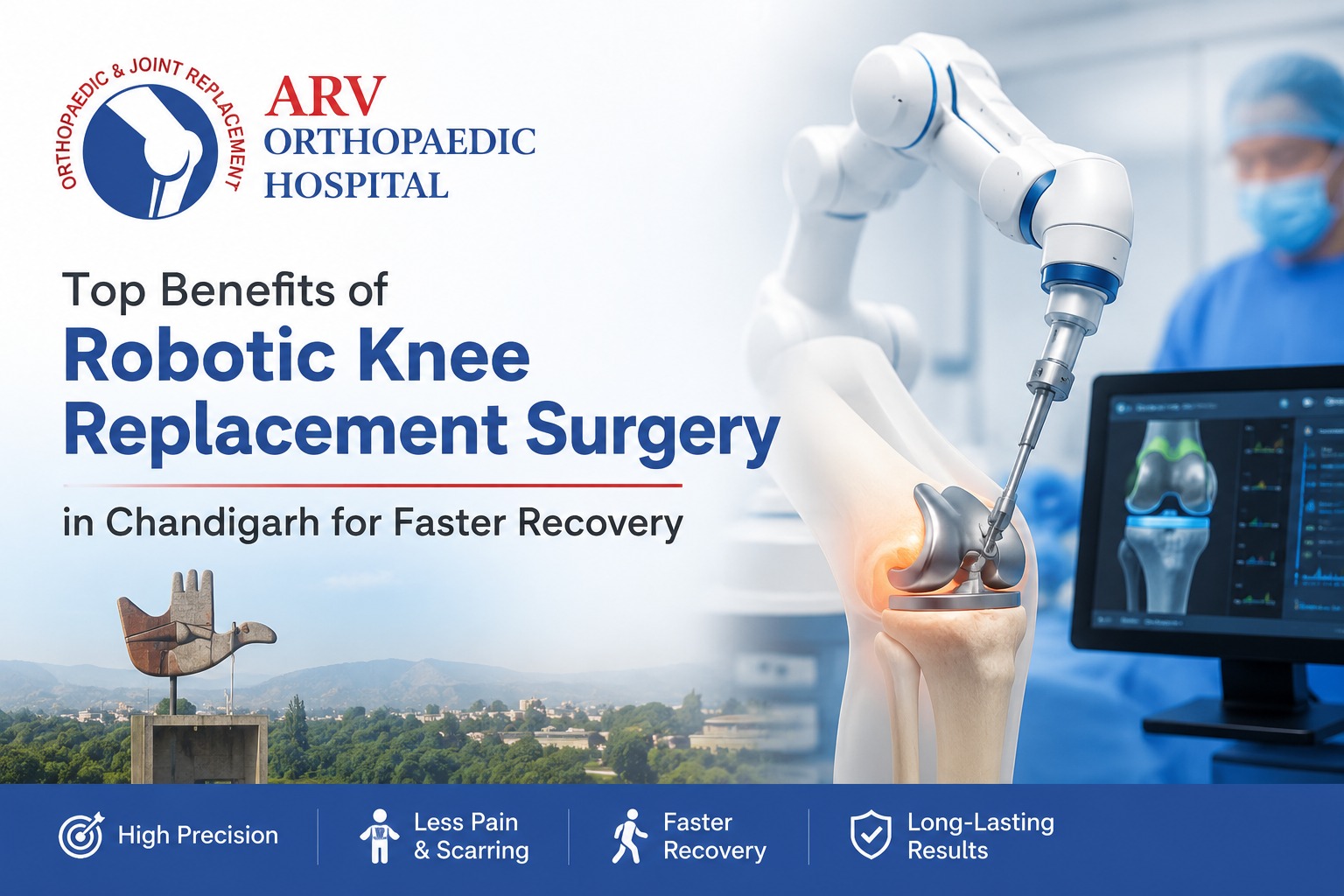
Today, robotic knee replacement surgery in Chandigarh is offering patients an advanced, technology-assisted approach to knee replacement. By combining the expertise of an orthopaedic surgeon with computer-assisted planning and robotic guidance, the procedure can help achieve more precise implant positioning and a treatment plan tailored to the patient’s knee anatomy.
At ARV Orthopaedic Hospital, robotic-assisted knee replacement is supported by experienced orthopaedic specialists, modern infrastructure, and structured rehabilitation care.
What Is Robotic Knee Replacement Surgery?
Robotic knee replacement is not a procedure in which a robot independently performs the operation. Instead, the orthopaedic surgeon remains in complete control while robotic technology assists with surgical planning, anatomical mapping, bone preparation, and implant positioning.
The technology can create a detailed, patient-specific plan and provide real-time guidance during surgery. This allows the surgeon to work with greater precision while aiming to preserve appropriate healthy bone and surrounding soft tissue.
For patients exploring Robotic knee replacement in Tricity, the combination of advanced technology, surgeon expertise, and comprehensive rehabilitation can be an important consideration.
Top Benefits of Robotic Knee Replacement Surgery in Chandigarh
1. Greater Surgical Precision
One of the key advantages of robotic-assisted knee replacement is precision. The system helps the surgeon plan and execute bone cuts and implant positioning according to the patient’s individual anatomy.
Accurate alignment is important because it can influence knee stability, movement, function, and the distribution of forces across the artificial joint.
2. Personalized Surgical Planning
Every patient’s knee anatomy is different. Robotic technology enables a more individualized approach by using detailed anatomical information to develop a surgical plan.
Instead of relying solely on generalized measurements, the surgeon can plan implant size, positioning, and alignment around the patient’s specific knee structure.
3. Potentially Less Trauma to Surrounding Tissues
Robotic guidance may help the surgeon work within carefully defined surgical boundaries. When appropriate, this can help minimize unnecessary disruption to surrounding bone and soft tissue.
Less tissue trauma may contribute to reduced post-operative discomfort and make early rehabilitation easier for some patients.
4. Earlier Mobilization After Surgery
One of the major goals of modern knee replacement is to help patients begin moving safely as soon as possible.
Following surgery, patients are generally encouraged to start appropriate movement and physiotherapy under professional supervision. Depending on overall health, surgical findings, and the rehabilitation plan, many patients can begin walking with assistance soon after the procedure.
However, recovery is not identical for everyone. Age, fitness, medical conditions, surgical complexity, pain management, and commitment to physiotherapy all influence the timeline.
5. Support for a Faster and More Comfortable Recovery
A precisely planned and executed procedure may support a smoother recovery by reducing unnecessary tissue disruption and helping restore appropriate knee alignment.
Patients should remember that robotic assistance does not automatically guarantee a faster recovery. Current evidence suggests that robotic systems can improve aspects of surgical precision, while the effect on recovery and long-term clinical outcomes can vary between patients and procedures. Surgeon expertise and quality rehabilitation remain essential.
6. Improved Knee Alignment and Joint Function
Correct implant alignment is an important part of successful knee replacement. Robotic assistance can help surgeons achieve the planned alignment with a high degree of consistency.
Proper alignment may support knee stability and functional movement, helping patients gradually return to activities such as walking, climbing stairs, and performing everyday tasks.
7. Structured Rehabilitation and Return to Daily Activities
Surgery is only one part of knee replacement recovery. Physiotherapy plays an equally important role.
A structured rehabilitation program can focus on:
- Restoring knee flexibility
- Improving muscle strength
- Reducing stiffness
- Developing balance and coordination
- Improving walking ability
- Gradually returning to everyday activities
At ARV Hospital, post-operative physiotherapy and rehabilitation form an important part of the overall joint replacement care pathway.
Who May Benefit From Robotic Knee Replacement?
Robotic-assisted knee replacement may be considered for patients with significant knee damage or advanced arthritis when non-surgical treatments are no longer providing sufficient relief.
Common symptoms that warrant an orthopaedic evaluation include:
- Persistent or worsening knee pain
- Difficulty walking or climbing stairs
- Knee stiffness that affects daily activities
- Pain that interferes with sleep
- Reduced range of motion
- Knee deformity or instability
- Difficulty performing routine activities despite conservative treatment
The decision to undergo robotic knee replacement should always be made after a detailed evaluation by a qualified orthopaedic surgeon. Robotic surgery is not automatically the best option for every patient.
Why Choose ARV Hospital for Robotic Knee Replacement in Chandigarh?
Choosing a knee replacement centre involves more than choosing a technology. The experience of the surgical team, patient assessment, operating-room standards, anaesthesia and nursing care, rehabilitation, and follow-up all contribute to the overall treatment journey.
ARV Orthopaedic Hospital in Chandigarh provides robotic-assisted joint replacement along with orthopaedic consultation, modern operation facilities, and physiotherapy and rehabilitation support.
For patients searching for advanced Robotic knee replacement in Tricity, a personalized consultation can help determine whether robotic-assisted surgery is appropriate for their condition.
Recovery After Robotic Knee Replacement
Recovery generally happens in stages rather than overnight.
Early recovery
The initial focus is on pain control, safe movement, swelling management, and beginning physiotherapy.
First few weeks
Patients progressively work on walking, knee flexibility, strength, and independence with everyday activities.
Following weeks and months
Continued exercises and follow-up help improve strength, range of motion, balance, and overall knee function.
The exact recovery period varies from person to person. Following the surgeon’s instructions, attending physiotherapy sessions, maintaining a healthy lifestyle, and attending follow-up appointments can support the best possible recovery.
Frequently Asked Questions
1. What is robotic knee replacement surgery?
Robotic knee replacement is a surgeon-controlled knee replacement procedure in which robotic and computer-assisted technology helps with surgical planning and precision during the operation.
2. Is robotic knee replacement better than conventional knee replacement?
Robotic assistance can offer advantages in surgical planning and implant positioning. However, it does not guarantee better outcomes for every patient. The choice should be based on individual anatomy, diagnosis, surgeon assessment, and available treatment options.
3. Does robotic knee replacement provide faster recovery?
Robotic-assisted surgery may support early mobility and recovery in appropriate patients, particularly when combined with effective pain management and rehabilitation. However, recovery varies considerably between individuals.
4. How soon can I walk after robotic knee replacement?
Many patients are mobilized with assistance soon after surgery, depending on their medical condition and the surgeon’s rehabilitation protocol. Your surgeon and physiotherapist will determine when and how much you should walk.
5. Is robotic knee replacement painful?
Some pain and discomfort are expected after knee replacement surgery. Modern pain-management techniques, careful surgical techniques, and physiotherapy can help manage post-operative discomfort.
6. Who is a candidate for robotic knee replacement?
Patients with advanced arthritis, significant joint damage, chronic knee pain, reduced mobility, or deformity may be considered after a thorough orthopaedic assessment. Not every patient requires or benefits from robotic-assisted surgery.
7. Does the robot perform the knee replacement independently?
No. The orthopaedic surgeon performs and controls the operation. The robotic system is an advanced surgical-assistance tool that helps the surgeon plan and execute the procedure with greater precision.
Contact ARV Hospital
ARV Orthopaedic Hospital
Address: #2125, Sarovar Path, Sector 21C, Chandigarh, 160022
Open: 24×7 hrs
Phone: 0172 400 5596, 271 1978, 8427452125
Email: dratulmalhotra.23@gmail.com
Connect With Us
Facebook: https://www.facebook.com/ARVHospital
YouTube: www.youtube.com/@arvorthopaedichospitalchan2953
Conclusion
For people living with severe knee arthritis or persistent joint pain, robotic-assisted knee replacement represents an important advancement in modern orthopaedic care. Greater surgical precision, personalized planning, careful tissue management, early mobilization, and structured rehabilitation can help create a smoother recovery pathway for appropriately selected patients.
If you are considering robotic knee replacement surgery in Chandigarh, consult an experienced orthopaedic surgeon to understand whether robotic-assisted knee replacement is suitable for your condition. At ARV Orthopaedic Hospital, patients can discuss their symptoms, imaging, treatment options, expected recovery, and rehabilitation plan before making an informed decision.
Book a consultation with ARV Orthopaedic Hospital to explore whether robotic-assisted knee replacement is right for you.