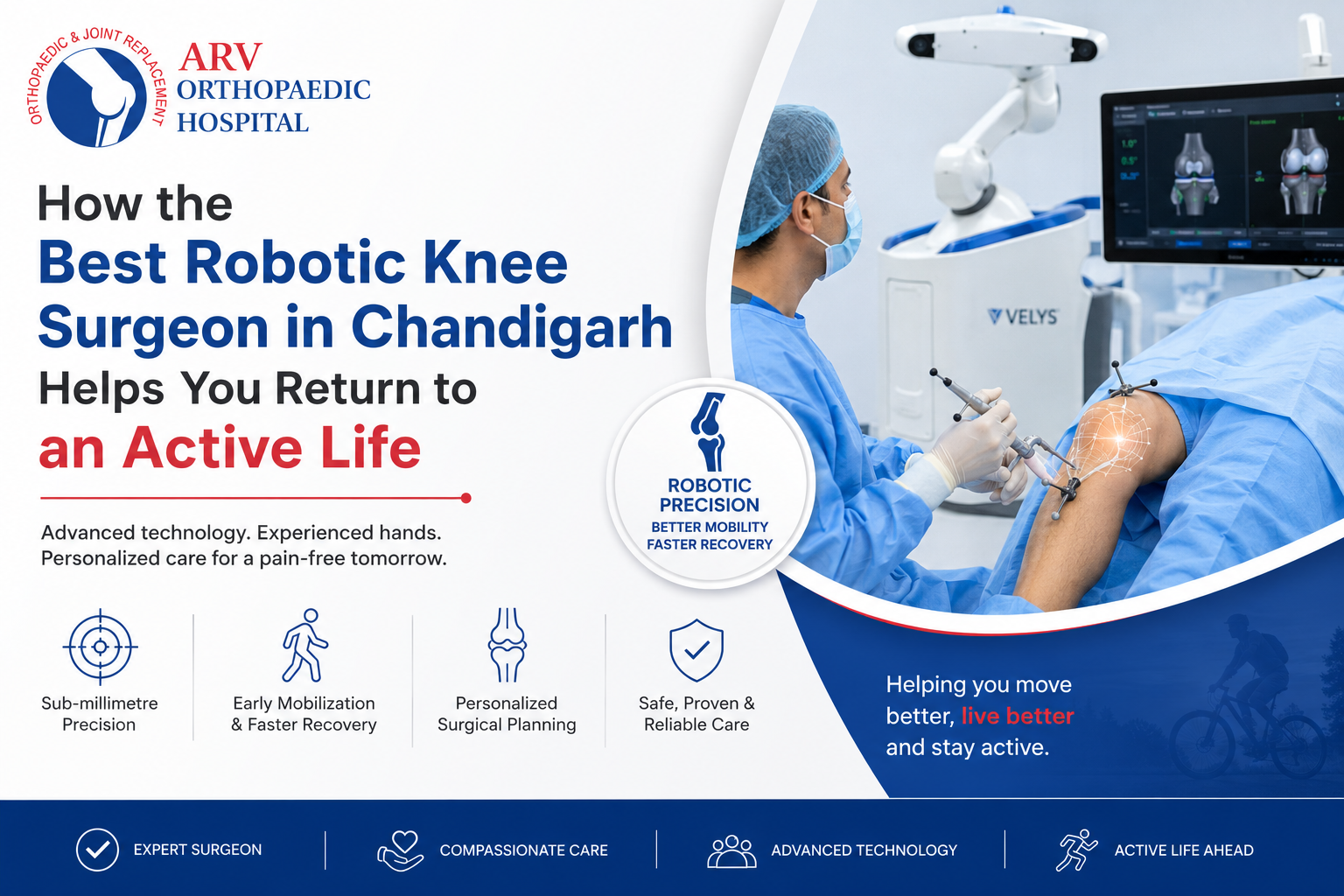
Knee pain can gradually change the way you live. A short walk may become uncomfortable, climbing stairs may feel exhausting, and activities you once enjoyed—cycling, travelling, exercising, or spending time outdoors—can start to feel out of reach.
When advanced knee arthritis or joint damage no longer responds adequately to medicines, physiotherapy, injections, or lifestyle changes, knee replacement may become an option. Today, robotic-assisted technology can help an experienced orthopaedic surgeon plan and perform knee replacement with a high degree of precision.
For patients considering treatment, choosing the Best Robotic knee surgeon Chandigarh offers more than access to advanced technology. The right surgeon combines clinical experience, careful patient selection, precise surgical planning, and structured rehabilitation to help you work towards a more active life.
At ARV Orthopaedic Hospital, Dr. Atul Malhotra is a VELYS-certified orthopaedic surgeon and performed the first VELYS robotic knee replacement in the Chandigarh Tricity region.
What Does Robotic Knee Replacement Actually Mean?
Robotic knee replacement does not mean that a robot independently performs your operation.
Instead, the robotic system works as an advanced surgical assistance and planning technology. Your orthopaedic surgeon remains responsible for the procedure, while the system helps with surgical planning, alignment, positioning, and execution according to the patient’s anatomy.
At ARV Orthopaedic Hospital, the VELYS robotic system is used to support personalised knee replacement planning and precise implant positioning. The hospital states that the system offers sub-millimetre placement precision.
The goal is straightforward: replace the damaged parts of the knee while preserving healthy bone and soft tissue as appropriately as possible and creating a knee that supports comfortable movement.
Why Choosing the Right Robotic Knee Surgeon Matters
Robotic technology is only one part of a successful knee replacement. The surgeon’s judgement remains critical before, during, and after surgery.
A qualified robotic knee specialist should assess:
- The severity and location of arthritis
- Your knee alignment and deformity
- Bone quality and overall health
- Your mobility and activity level
- Previous treatments and surgeries
- Your expectations after replacement
- Your rehabilitation requirements
This personalised approach is particularly important because not every patient with knee pain needs knee replacement, and not every patient is necessarily a candidate for robotic-assisted surgery.
At ARV Hospital, treatment options include joint preservation, physiotherapy-based management, total knee replacement, robotic knee replacement, and other orthopaedic procedures depending on the patient’s condition.
How Robotic Assistance Can Support Your Return to Activity
1. More Personalised Surgical Planning
Every knee is different. Arthritis can affect the joint unevenly, and individual anatomy varies from patient to patient.
Robotic-assisted planning allows the surgical team to assess the patient’s knee anatomy and create a procedure tailored to that individual rather than relying solely on a standard approach.
A personalised plan can help the surgeon make informed decisions about alignment, implant positioning, and bone preparation.
2. Greater Precision During Implant Placement
Implant positioning is an important part of knee replacement.
The VELYS system used at ARV Orthopaedic Hospital is designed to assist the surgeon with accurate positioning and alignment. ARV reports robotic placement precision of up to 0.5 mm.
The purpose of this precision is not simply to achieve an impressive measurement. It is to help create a well-balanced knee that can support movement and rehabilitation.
3. A Focus on Early Mobility
After knee replacement, rehabilitation begins early.
ARV Hospital reports that many patients begin walking and mobilising with assistance within approximately 24 hours, although the exact recovery experience varies from patient to patient.
Early movement is an important part of recovery because it helps patients gradually rebuild strength, confidence, flexibility, and independence.
4. Structured Rehabilitation After Surgery
Surgery is only one stage of your recovery.
Physiotherapy and rehabilitation help you:
- Restore knee movement
- Strengthen the muscles around the knee
- Improve balance and stability
- Build confidence while walking
- Gradually return to everyday activities
- Progress towards appropriate recreational activities
Your rehabilitation plan should be adjusted according to your recovery, age, health, strength, and lifestyle goals.
Robotic Knee Replacement in Tricity: Who May Benefit?
People living in Chandigarh, Mohali, and Panchkula often look for advanced treatment options close to home. Robotic knee replacement in Tricity can be considered for suitable patients with significant knee arthritis or joint damage when conservative treatment has not provided sufficient relief.
Common symptoms that may indicate the need for an orthopaedic assessment include:
- Persistent knee pain
- Difficulty walking
- Pain while climbing stairs
- Knee stiffness
- Reduced ability to exercise
- Difficulty standing for longer periods
- Pain that interferes with sleep or daily activities
- Increasing dependence on pain medication
However, symptoms alone do not determine whether you need surgery. A detailed clinical examination and appropriate imaging are necessary before deciding on treatment.
What Can You Expect After Surgery?
Recovery is individual. Some patients progress quickly, while others require more time.
At ARV Hospital, the reported recovery pathway includes early mobilisation, hospital-based care, and physiotherapy. The hospital states that many patients walk within 24 hours and that stair management may take several weeks, while fuller recovery can take a few months.
Your recovery may involve:
Early days:
Pain management, assisted walking, exercises, and monitoring.
First few weeks:
Progressive physiotherapy, improving range of motion, and gradually increasing walking.
Following weeks:
Building strength, improving balance, and becoming more independent with everyday activities.
Later recovery:
Returning to appropriate low-impact activities according to your surgeon and physiotherapist’s advice.
The aim is not simply to complete surgery. The aim is to help you regain useful mobility and confidence.
Returning to an Active Lifestyle
For many patients, an active life does not necessarily mean competitive sports. It can mean being able to walk comfortably through a market, travel with family, climb stairs, play with grandchildren, exercise, or enjoy a morning walk without constantly thinking about knee pain.
Once your surgeon confirms that your recovery is progressing appropriately, activities can usually be increased gradually.
Low-impact activities such as walking, swimming, cycling, and suitable strengthening exercises may form part of a long-term active lifestyle. Your orthopaedic team can advise you about which activities are appropriate for your individual knee replacement.
Why Consider ARV Orthopaedic Hospital?
ARV Orthopaedic Hospital is located in Sector 21C, Chandigarh, and focuses on orthopaedic and joint replacement care.
Dr. Atul Malhotra has completed MBBS, MS Orthopaedics, and DNB training, received training in Singapore, and is VELYS certified. ARV states that he performed the first VELYS robotic knee replacement in the Chandigarh Tricity region.
The hospital also provides total knee replacement, hip replacement, sports injury and arthroscopy care, fracture treatment, revision joint replacement, and joint-preservation services.
Most importantly, your treatment should be based on your medical condition—not simply on whether robotic technology is available. A consultation can help determine whether non-surgical treatment, conventional replacement, partial replacement, or robotic-assisted replacement is appropriate for you.
When Should You Consult a Robotic Knee Specialist?
Consider an orthopaedic evaluation if knee pain is consistently affecting your quality of life or preventing you from doing activities you previously enjoyed.
You should not wait until every activity becomes difficult.
An early assessment can clarify:
- What is causing your knee pain?
- How advanced is the joint damage?
- Can conservative treatment still help?
- Are you a suitable candidate for knee replacement?
- Would robotic-assisted surgery be appropriate?
- What recovery and rehabilitation would look like for you?
The right treatment is the one that fits your condition, goals, and overall health.
Take the First Step Towards an Active Life
Living with chronic knee pain can gradually make your world smaller. Modern orthopaedic treatment aims to change that.
With careful patient selection, experienced surgical judgement, robotic-assisted precision, and dedicated rehabilitation, knee replacement can help suitable patients work towards improved mobility and a more active lifestyle.
If you are considering robotic-assisted knee replacement, consult an experienced orthopaedic specialist to understand whether the procedure is right for you.
Frequently Asked Questions
1. Who is the Best Robotic Knee Surgeon Chandigarh patients can consult?
The choice of surgeon should be based on qualifications, robotic-system certification, experience with knee replacement, surgical approach, hospital facilities, and the surgeon’s ability to provide appropriate pre- and post-operative care. At ARV Orthopaedic Hospital, Dr. Atul Malhotra is a VELYS-certified orthopaedic surgeon and performed the first VELYS robotic knee replacement in the Chandigarh Tricity region.
2. Is robotic knee replacement better than traditional knee replacement?
Robotic assistance can provide additional planning and precision during surgery, but it is not automatically the best option for every patient. The appropriate technique depends on your anatomy, arthritis, overall health, and surgeon’s assessment.
3. Does the robot perform the knee replacement surgery?
No. The orthopaedic surgeon performs the operation. The robotic system acts as a surgical assistance and planning technology under the surgeon’s control.
4. How quickly can I walk after robotic knee replacement?
Many patients can begin assisted walking and mobilisation within about 24 hours, but recovery varies according to individual health, surgery, strength, and rehabilitation progress.
5. How long does recovery take?
Recovery varies from person to person. Patients may regain everyday mobility progressively over several weeks, while fuller recovery can take a few months. Your surgeon and physiotherapist will guide your progression.
6. Can I return to exercise after knee replacement?
Many patients can return to suitable low-impact physical activities after recovery. The timing and type of exercise should be discussed with your surgeon and physiotherapist based on your individual progress.
7. Is everyone with knee arthritis suitable for robotic replacement?
No. The need for surgery and suitability for robotic-assisted replacement must be assessed individually. In some cases, medicines, physiotherapy, injections, lifestyle changes, or other joint-preservation treatments may still be appropriate.
Contact ARV Hospital
ARV Orthopaedic Hospital
Address: #2125, Sarovar Path, Sector 21C, Chandigarh, 160022
Open: 24×7 hrs
Phone: 0172 400 5596, 271 1978, 8427452125
Email: dratulmalhotra.23@gmail.com
Connect With Us
Facebook: https://www.facebook.com/ARVHospital