Knee pain can gradually change the way you live. Climbing stairs, walking, exercising, or even standing for long periods can become difficult when arthritis or severe joint damage affects the knee.
For patients who eventually need knee replacement, advances in technology have introduced another option to consider: robotic-assisted knee replacement.
But is robotic surgery actually better than traditional knee replacement? What does the robot do? Is it safer? Does it mean a faster recovery? And, most importantly, how do you choose the best robotic surgeon in Chandigarh?
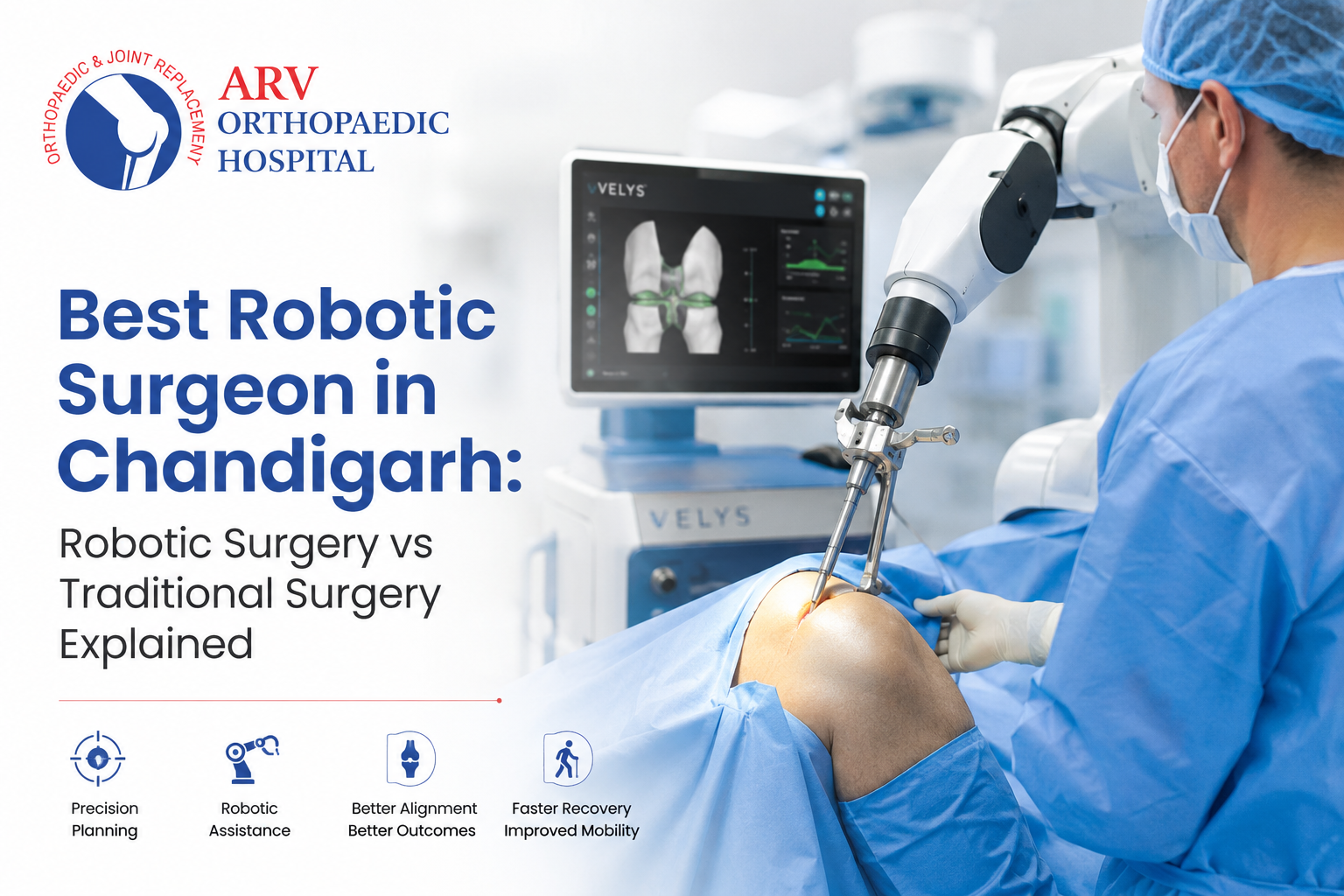
At ARV Orthopaedic Hospital Chandigarh, robotic-assisted joint replacement is performed with the surgeon remaining fully in control of the procedure. The VELYS robotic system is used to support detailed planning and precise execution during knee replacement. Dr. Atul Malhotra is the first VELYS robotic joint replacement surgeon in the Chandigarh Tricity region, according to the hospital.
This guide explains the key differences between robotic-assisted and traditional knee replacement so you can have a more informed conversation with your orthopaedic surgeon.
What Is Robotic-Assisted Knee Replacement?
Robotic-assisted knee replacement is not a surgery performed independently by a robot.
Instead, it combines the experience and decision-making of an orthopaedic surgeon with computer-assisted robotic technology.
Before surgery, the patient’s knee anatomy can be mapped and used to develop an individualized surgical plan. During the procedure, the robotic system helps the surgeon execute that plan with a high degree of precision.
The surgeon remains responsible for:
- Evaluating the patient’s condition
- Deciding whether knee replacement is appropriate
- Planning the operation
- Performing the surgical procedure
- Making clinical decisions during surgery
- Selecting and positioning the appropriate implant
In other words, robotic technology assists the surgeon; it does not replace the surgeon.
What Is Traditional Knee Replacement?
Traditional or conventional knee replacement has been successfully performed for decades.
In a conventional procedure, the surgeon uses established surgical techniques, instruments, anatomical landmarks and imaging to remove damaged portions of the knee and position the replacement components.
The success of traditional knee replacement depends heavily on the surgeon’s training, experience, surgical planning and execution.
Traditional surgery remains an effective treatment for many patients, and robotic assistance is not automatically necessary for every knee replacement.
Robotic Surgery vs Traditional Surgery: Key Differences
The most important difference is the way the surgery is planned and executed.
| Feature | Robotic-Assisted Knee Replacement | Traditional Knee Replacement |
|---|---|---|
| Surgical control | Surgeon remains fully in control | Surgeon remains fully in control |
| Pre-operative planning | Computer-assisted, patient-specific planning may be used | Conventional planning and imaging |
| Surgical guidance | Robotic system provides real-time assistance | Surgeon relies on conventional instruments and techniques |
| Implant positioning | Technology can assist with highly precise positioning | Relies primarily on surgical technique and conventional instruments |
| Personalization | Can allow detailed planning based on individual anatomy | Planning is based on standard measurements and surgical assessment |
| Technology requirement | Requires specialized robotic platform and trained team | Uses conventional surgical equipment |
| Cost | May be higher because of advanced technology | Generally less technology-intensive |
| Suitability | Depends on the patient’s condition and surgeon’s assessment | Suitable for many knee replacement patients |
The right choice is ultimately patient-specific. The presence of robotic technology alone does not determine whether it is the best treatment for a particular patient.
What Are the Potential Advantages of Robotic-Assisted Surgery?
1. Greater Precision in Surgical Planning
One of the major reasons robotic systems are used in joint replacement is their ability to support highly detailed planning.
At ARV Orthopaedic Hospital, the VELYS system is used for patient-specific planning and robotic assistance, with the hospital reporting sub-millimetre placement precision.
Precise positioning is important because the alignment and positioning of knee replacement components can influence joint mechanics and function.
2. Individualized Surgical Planning
Every knee is different.
Patients can have variations in bone anatomy, alignment, deformity and soft-tissue balance. Robotic-assisted systems can help the surgeon account for these individual characteristics while developing a surgical plan.
This can make the procedure more personalized rather than relying solely on standard measurements.
3. Real-Time Surgical Guidance
During surgery, robotic technology can provide the surgeon with information and guidance based on the patient’s anatomy and the pre-operative plan.
The technology is designed to assist with controlled bone preparation and component positioning while the surgeon makes the final decisions.
4. Focus on Implant Alignment and Positioning
Correct implant positioning is an important part of knee replacement surgery.
Poor positioning or alignment can potentially affect knee movement, stability, comfort and implant performance. Robotic assistance is intended to help the surgeon achieve the planned positioning with greater precision.
5. Potentially Earlier Rehabilitation
Some patients undergoing robotic-assisted knee replacement may experience a smooth early recovery and begin mobilization quickly.
However, recovery is influenced by many factors, including:
- Age
- Overall health
- Muscle strength
- Severity of arthritis
- Surgical technique
- Pain management
- Physiotherapy
- Patient participation in rehabilitation
Therefore, robotic surgery should not be marketed as a guarantee of faster recovery.
Research comparing robotic and conventional surgery across different procedures has found that the benefits can vary considerably depending on the operation, and stronger evidence is still needed for some patient-important outcomes.
Is Robotic Knee Replacement Better Than Traditional Surgery?
There is no universal answer.
Robotic-assisted surgery offers technological advantages, particularly in planning, alignment and surgical guidance. However, the technology does not automatically make every operation better or every patient a candidate.
Scientific reviews have found that outcomes can differ depending on the type of surgery and comparison being made. In some settings, robotic surgery has demonstrated advantages in areas such as blood loss or certain recovery measures, while other outcomes may be similar to conventional approaches.
For knee replacement, the most important question should therefore not simply be:
“Is robotic surgery better?”
Instead, ask:
“Is robotic-assisted surgery appropriate for my knee, and is it being performed by an experienced joint replacement surgeon?”
Who May Benefit From Robotic Knee Replacement?
Robotic-assisted knee replacement may be considered for patients with significant knee arthritis or joint damage when non-surgical treatment is no longer providing adequate relief.
Potential candidates may include people experiencing:
- Advanced knee osteoarthritis
- Persistent knee pain
- Difficulty walking or climbing stairs
- Significant stiffness
- Knee deformity or alignment problems
- Reduced ability to perform everyday activities
- Failure of appropriate non-surgical treatments
However, candidacy must be determined through a proper clinical examination and appropriate imaging.
Sometimes, surgery can be avoided or postponed with physiotherapy, weight management, medication, injections, activity modification or other joint-preservation approaches.
How to Choose the Best Robotic Surgeon in Chandigarh
Choosing a robotic surgeon should involve much more than looking for a hospital that owns a robotic system.
Consider the following factors.
1. Orthopaedic Training and Experience
Ask about the surgeon’s qualifications, joint replacement experience and specific experience with robotic-assisted procedures.
2. Experience With Robotic Technology
Robotic systems require specialized training. Ask how frequently the surgeon performs robotic joint replacement and what certification or training they have received.
At ARV Orthopaedic Hospital, Dr. Atul Malhotra is described by the hospital as VELYS certified and as having performed the first VELYS robotic knee replacement in the Chandigarh Tricity region in 2023.
3. The Technology Being Used
Not all robotic systems are identical.
Ask your surgeon which robotic platform is being used and how it assists with your particular procedure.
4. Personalized Treatment Planning
A good surgical plan should be based on your anatomy, symptoms, lifestyle and expectations, rather than technology alone.
5. Rehabilitation Support
Successful knee replacement does not end when surgery is completed.
Physiotherapy, pain management, walking exercises and follow-up care are important parts of recovery.
6. Honest Discussion of Alternatives
A trustworthy surgeon should also tell you when robotic surgery is not necessary.
If physiotherapy, medication, injections or other treatments may help, those options should be discussed before proceeding with joint replacement.
Why Consider ARV Orthopaedic Hospital for Robotic Knee Replacement in Chandigarh?
ARV Orthopaedic Hospital in Sector 21C, Chandigarh, provides orthopedic and joint replacement services, including robotic knee replacement.
The hospital states that it uses the VELYS robotic system, with Dr. Atul Malhotra serving as its chief surgeon and being the first VELYS robotic joint replacement surgeon in the Chandigarh Tricity region.
The hospital’s orthopedic services include:
- Robotic Knee Replacement
- Total Knee Replacement
- Hip Replacement
- Sports Injuries & Arthroscopy
- Fracture Treatment
- Revision Joint Replacement
- Joint Preservation
ARV also emphasizes that treatment should be tailored to the patient’s condition rather than choosing technology simply because it is newer.
What Is Recovery Like After Robotic Knee Replacement?
Recovery varies from patient to patient.
Many modern knee replacement programs encourage early mobilization, often beginning walking soon after surgery when medically appropriate.
At ARV Orthopaedic Hospital, the hospital reports that many patients walk within 24 hours, with discharge commonly around day 3–4 and progression toward normal activities over the following weeks and months.
Your recovery may be influenced by:
- Your age and general health
- Pre-operative mobility
- Muscle strength
- Surgical complexity
- Pain control
- Physiotherapy
- Commitment to rehabilitation
- Any underlying medical conditions
It is important not to compare your recovery timeline directly with another patient’s.
Frequently Asked Questions
Does a robot perform knee replacement surgery?
No. The orthopaedic surgeon performs the operation. The robotic system is a technology platform that assists with planning and surgical execution while the surgeon remains in control.
Is robotic knee replacement safe?
Robotic-assisted knee replacement can be performed safely when the patient is appropriately selected and the procedure is performed by a trained surgical team. Like every major operation, knee replacement carries potential risks, which should be discussed during consultation.
Is robotic knee replacement less painful?
Some patients may experience a comfortable recovery, but pain varies from person to person. Robotic technology should not be considered a guarantee of less pain.
Does robotic surgery guarantee faster recovery?
No. Robotic assistance may support precise surgery and early rehabilitation, but recovery depends on multiple patient and treatment factors.
Is robotic knee replacement more expensive than traditional surgery?
It can be. Advanced robotic technology, equipment and planning may increase the cost of treatment. The exact cost depends on the procedure, implant, hospital stay and individual treatment plan.
How long does a knee replacement implant last?
Modern knee implants can provide many years of service, but implant longevity varies according to factors such as implant design, positioning, patient activity, body weight, age and other individual factors. Your surgeon can provide a more personalized estimate.
Should everyone choose robotic knee replacement?
No. Robotic surgery is not automatically the best choice for every patient. Your surgeon should assess your knee, overall health, symptoms and treatment goals before recommending the appropriate approach.
Final Thoughts
If you are searching for the Robotic Joint Replacement in Chandigarh, don’t make your decision based on the word “robotic” alone.
The most important combination is an experienced orthopaedic surgeon + appropriate patient selection + advanced technology + individualized surgical planning + structured rehabilitation.
Robotic-assisted knee replacement can offer valuable advantages in surgical planning and precision, but traditional knee replacement remains an effective option for many patients. The right procedure is the one that is medically appropriate for your specific knee and performed by a qualified, experienced surgical team.
If persistent knee pain is affecting your walking, sleep or everyday activities, a consultation with an experienced orthopaedic surgeon can help determine whether physiotherapy, joint-preservation treatment, conventional replacement or robotic-assisted knee replacement is appropriate for you.
Contact ARV Hospital
ARV Orthopaedic Hospital
Address: #2125, Sarovar Path, Sector 21C, Chandigarh, 160022
Open: 24×7 hrs
Phone: 0172 400 5596, 271 1978, 8427452125
Email: dratulmalhotra.23@gmail.com
Connect With Us
Facebook: https://www.facebook.com/ARVHospital